
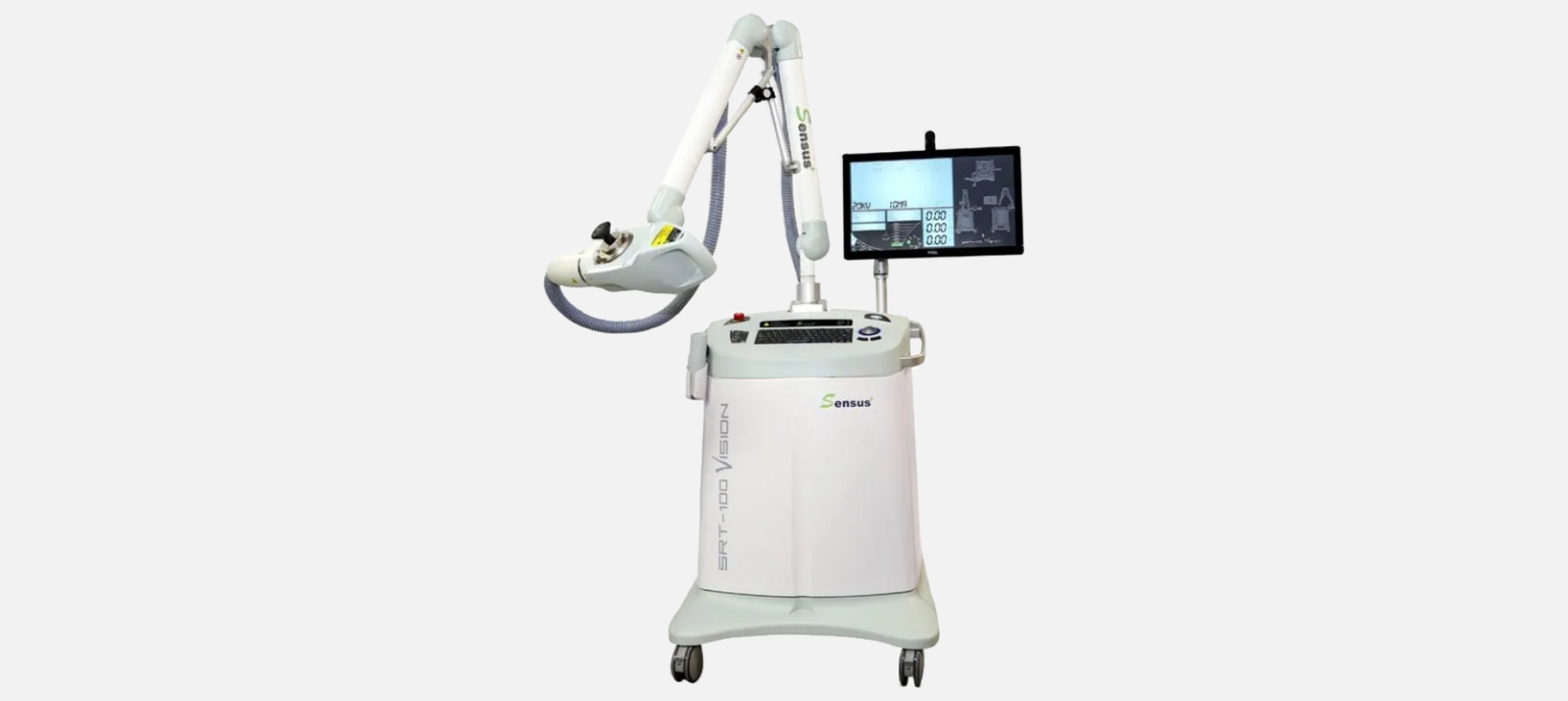
Link has been copied! Date:August 14, 2026 Back to Blog Owning Your SRT Program vs. Outsourcing: What Dermatologists Should Know If you are a dermatology practice owner thinking about bringing Superficial Radiotherapy (SRT) into your clinic, your evaluation likely identified two options: either by owning the SRT or partnering with a service provider.
For practice owners, the choice depends on what’s important for your clinic today – and how it’ll evolve with your future needs.
The ownership model is straightforward. You:
Own the patient experience, including the schedule and treatment plan
Bill under your own NPI and keep the full reimbursement.
In short: you own the program, the patient relationship, and the revenue. It does mean that the practice carries the upfront cost and the operational responsibility.
Partnering with a service provider to bring SRT into your clinic –commonly referred to as the service model – works differently.
A third party provides the device and staffs the program within your practice. There is no upfront capital required. Instead, the provider takes a significant share of each procedure’s reimbursement — typically 50% or more — in exchange for running the program. The arrangement is often structured as a long-term agreement with renewal provisions.
At the surface, it looks like the tradeoff comes down to capital versus revenue share. But, that understates what is at stake for the clinic and patients when comparing the two SRT program options.
The Financials: Evaluating Ownership vs. Service Provider Over Time
Evaluating the economics of owning your own SRT or choosing a service provider becomes clearer when it’s modeled at scale.
Consider a practice delivering 10 SRT fractions – or individual treatment sessions – per week. Under the 2026 CPT codes, practices can be reimbursed around $450 to $550 per fraction. That equals roughly 480 treatment sessions across a 48-week clinical year – or approximately $240,000 in annual gross reimbursement.
Under ownership, the practice captures all of it. Subtract staffing costs, consumables, and a modest maintenance allocation, and the net margin is substantial. Most clinics recoup the device cost within 12 to 18 months at moderate volume, faster at higher volume. By year three of ownership, the device has paid for itself and the practice is running at full operational margin.
Under a revenue-sharing agreement at 50%, the practice keeps $120,000 in the first clinical year – while the service provider takes the other half. The difference compounds every year. By year three of a service agreement, the practice has sent a six-figure check to a third party every year — and will keep sending it as long as the agreement runs.
Modeling SRT Program Financial Performance
($240,000 minus device payoff and OpEx) $120,000 net
($120,000 sent to vendor) Year 2 $210,000 net
(Device paid off, full margin) $120,000 net
($120,000 sent to vendor) Year 3 $210,000 net
(Running at full operational margin) $120,000 net
($120,000 sent to vendor) Estimated Revenue $465,000 $360,000
Disclaimer & Model Assumptions: Figures are for illustrative and modeling purposes only. Actual financial performance and net revenues may vary based on geographic location, payer mix, local fee schedules, and individual clinical volume. Projections assume a constant volume of 10 fractions/week and do not account for year-over-year patient growth (typically averaging 10%–20% annually as program awareness expands) or annual inflationary fee schedule adjustments. Direct ownership estimates reflect full capital amortization in Year 1 and estimated routine operating and maintenance allocations.
The Patient Experience Under Each SRT Program
When you own the device, you set the patient schedule. You decide which lesions qualify. You run prior authorizations through your own billing team, who know your payers and your workflows. When a patient has a question about their treatment course, they call your front desk – not a third-party call center.
In a service arrangement, those decisions often sit with the service provider. The service provider will set the scheduling windows, and determine which staff member treats your patients. They will handle billing through their own systems. Essentially, the clinic becomes a host site – meaning that the patient experience becomes shared.
This is an important consideration. Dermatology, and many medical disciplines, are based on relationships. Patients who trust you, will continue to see you for care; as well as recommend you to others.
If a third party is delivering a significant portion of that care, the trust fractures and suddenly belongs to someone else who has become part of your medical workflows. Second, when billing issues arise, a split billing arrangement creates two parties for the patient and the payer to navigate, not one.
Staffing and Operational Considerations for SRT Programs
Evaluating the choice between SRT ownership and a third-party service model often comes down to your long-term staffing strategy.
Under direct ownership, you train your own medical assistants or radiation therapists to deliver SRT. Once your team is certified, it results in an in-house capability that does not expire and does not require revenue-sharing.
Under an agreement with a service provider, the staff belongs to the service provider. The training, hiring, and staff management belongs to them – so you never have to worry about staffing. It also means that you continually must rely on another organization for staffing issues, and never build an understanding of how to use SRT internally.
Practices that train their own teams report a secondary benefit: internal champions. Clinicians and staff who master SRT take personal pride in the program, advocating for non-invasive options for non-melanoma skin cancer and keloid care.
Cost can be a real objection for many clinicians. However, there are options available to help support financing needs.
Sensus Healthcare offers financing programs – including a Fair Deal Agreement structure – which helps to make ownership accessible without a large upfront capital commitment. This means that the device pays for itself out of procedure revenue, often within the first 12-18 months of operation.
Service providers offer revenue-sharing agreements, which require no upfront cost but requires a permanent percentage of every procedure.
The critical difference comes from the longevity of the program. For a clinician seeking a long-term opportunity to leverage SRT in their practice, ownership makes sense – financing has an endpoint, where revenue sharing does not.
How to Choose the SRT Program for Your Clinic
Selecting the best SRT program for your clinic comes down to what makes the most sense for your operations and long-term goals.
You have a clear line of sight to moderate or high patient volume.
You want SRT to be a permanent, branded service line of your practice.
You care about capturing the full reimbursement, owning the patient experience, and building long-term asset value.
You are testing SRT for the first time and want to validate patient demand.
Your projected volume is lower (less than four patients per month).
You want to offer SRT, but do not have the bandwidth to build the operational capability.
Staffing and financing are two considerations for building your SRT program. It’s also important to look at the future of dermatology and where a non-surgical treatment option like SRT fits within the practice.
The Medicare coding changes that took effect in 2026 recognize SRT as a standard treatment option with dedicated reimbursement codes. The policy environment continues to move towards access, choice, and competition. Practices that own SRT are now positioning themselves ahead of that curve.
Interested in seeing how owning your SRT program from Sensus Healthcare can work for your specific patient volume and payer mix? Schedule a meeting with a Sensus representative.